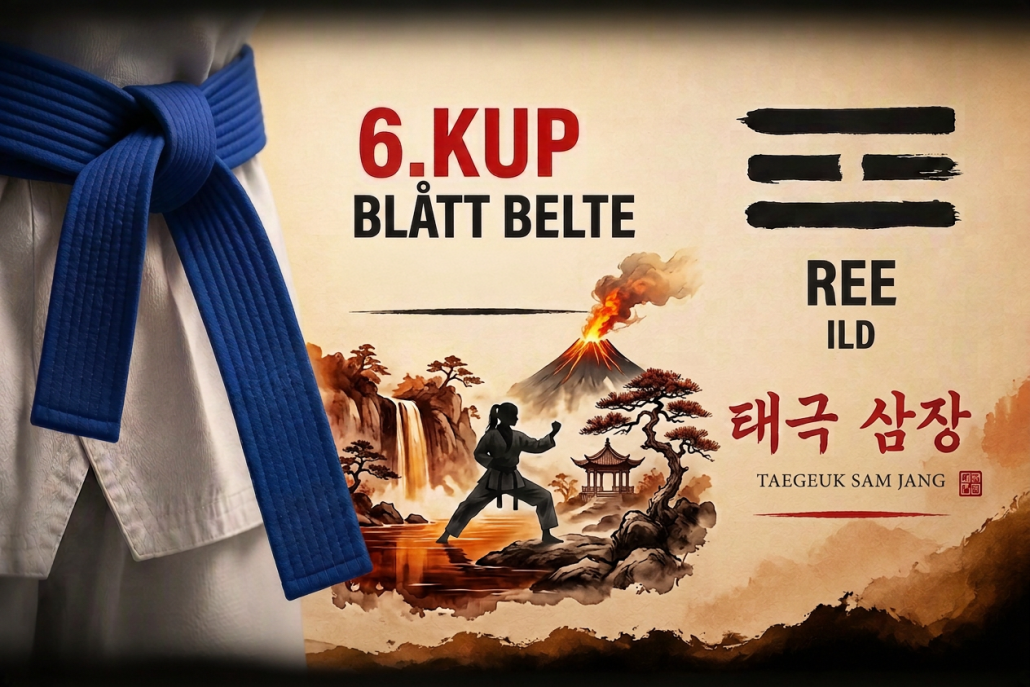
Taegeuk Sam Jang
태극 삼장
Taegeuk 3
“Teyh-Goog Sahm-Jahng”
6. kup Poomsae 3
Trigram: ☲ Ree (Ild)
Taegeuk Sam Jang representerer det tredje mønsteret i Taekwondo og er knyttet til trigrammet Ree (Ild og sol). Det symboliserer energi, varme, lys og en brennende lidenskap for utvikling.
Symbolikk: Ild, sol, lys og dynamisk livskraft.
Bevegelser: Introduserer mer sammensatte og eksplosive teknikkombinasjoner, som knivhåndsslag (hansonnal mok chigi), knivhåndsblokkering (hansonnal makki), samt raskere retningsendringer og kontinuerlige spark.
Filosofisk betydning: Som en ild som flammer opp, skal bevegelsene utføres med varme, engasjement og tydelig intensitet. Utøveren må kontrollere den eksplosive energien slik at den brenner med presisjon og klarhet, uten å miste balansen eller formen.
Taegeuk Sam-Jang
태극 삼장
Taegeuk 3
“Teyh-Goog Sahm-Jahng”
6th Geup Poomsae
Trigram: ☲ Fire
Taegeuk 3-Jang represents 리 Ri (火) in Palgwae. Ri symbolizes fire and clarity, like the sun. It corresponds with the heart in the human body, which further refers to the process of developing a courageous mindset. If you look at the nature of fire, it starts with a small spark and spreads rapidly, burning everything in an instant. Such uncontrolled force and light that spreads everywhere does not help Poomsae practice. Taegeuk 3-Jang is a practice method comprising the accurate learning of forces and techniques that correspond with fire and light, and practicing the bold moves by connecting defense and attack.
“In Taegeuk 3-Jang, new skills are learned using the Knife Hand. This goes beyond unclasping your fist; it means the change of attack and defense. Opening your hands allows you to implement the technique by catching the opponent. In Taegeuk 1-Jang and 2-Jang, the process involves creating power. In Taegeuk 3-Jang, the process involves learning how to use the opponent’s power by eliminating it or breaking their balance by combining the skills to grab and pull the opponent. Also, you will practice techniques, including the weight shift from 뒷 굽이 Dwit Gubi (Backward Stance) to 앞 굽이 Ap Gubi (Forward Stance), and connecting three skills such as 두번 지르기 Dubeon Jireugi (Double Punch) with 앞 차기 Ap Chagi (Front Kick) and 앞 차기 Ap Chagi (Front Kick) with 내려 막기 and 바로 지르기 Baro Jireugi (Reverse Punch).”