
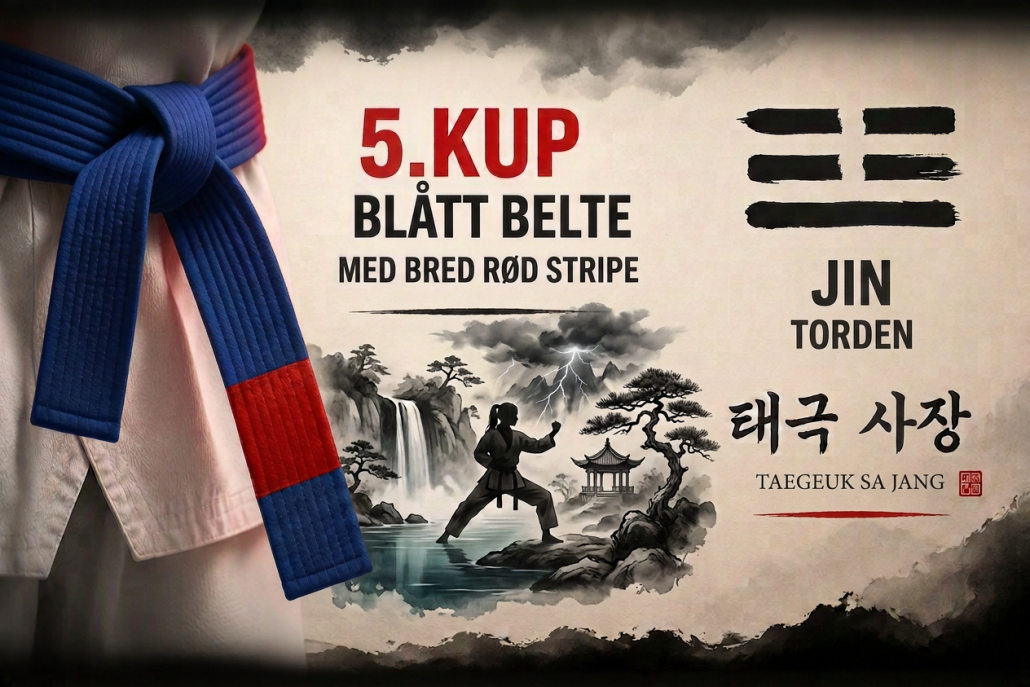
Taegeuk Sa-Jang
태극 사장
Taegeuk 4
“Teyh-Goog Sah-Jahng”
5. kup Poomsae
Trigram: ☳ Jin (Torden)
Taegeuk Sa Jang representerer det fjerde mønsteret i Taekwondo og er knyttet til trigrammet Jin (Torden). Det symboliserer enorm, fryktinngytende kraft, indre ro og urokkelig verdighet når man står overfor fare eller motgang.
Symbolikk: Torden, overveldende styrke, verdighet og mot.
Bevegelser: Legger stor vekt på avanserte håndteknikker med knivhånd, slik som dobbel knivhåndsblokkering (sonnal Geodeureo makki) og svale-blokkering/slag (sonnal jebipoom mok chigi), kombinert med siderpark (yop chagi) og dype, stabile stillinger som dwit kubi (bakstilling).
Filosofisk betydning: Torden skaper både frykt og respekt. Mønsteret lærer utøveren å forbli rolig og samlet i kriser, for så å reagere med resolutt, urokkelig kraft når situasjonen krever det – akkurat som torden lynraskt bryter gjennom stillheten.
Taegeuk Sa-Jang
태극 사장
Taegeuk 4
“Teyh-Goog Sah-Jahng”
5th Geup Poomsae
Trigram: ☳ Thunder
Taegeuk 4-Jang represents 진 Jin (雷) in Palgwae. Jin symbolizes arousing instant thunder and lightning. In the Orient, Jin is referred to as the dragon of heaven. In the human body, it represents mobility of both the feet which facilitate speedy movement and powerful kicks. Using the feet, you can twist your body to quickly change direction or attack. This is a process of attacking the opponent by taking advantage of the distance from the opponent, like an ever-changing dragon.
“In Taegeuk 4-Jang, where 손날 거들어 막기 Sonnal Geodeureo Makgi (Assisted Knife Hand Block) is introduced, you will learn the 찌르기 Jjireugi (Thrusting) skill and learn how to take a step back after 앞 차기 Ap Chagi (Front Kick) in order to respond to the counter attack. By practicing 등 주먹 앞 치기 Deung Jumeok Ap Chigi (Back Fist Forward Strike) you will strengthen the lower body and learn how the force is transmitted from the ground to the elbow, ending with the knuckles of your fist. 손날 거들어 막기 Sonnal Geodeureo Makgi signifies the quick connection between moves of the hand, for the complementary use of the first and next techniques, to learn the expandability of the techniques.”