Taegeuk I Jang
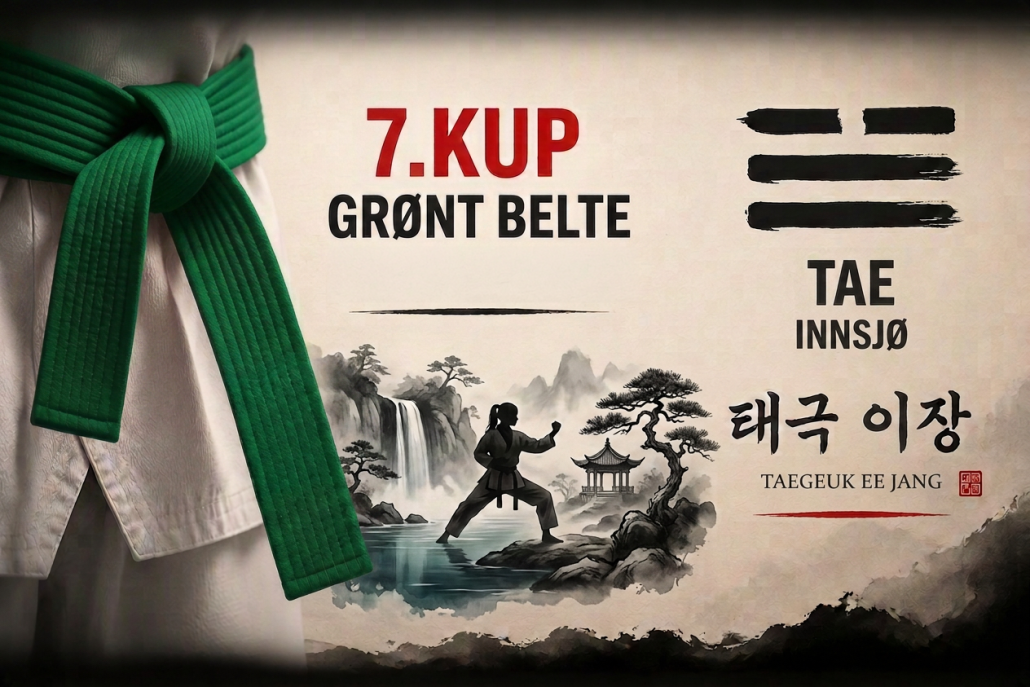
태극 이장
Taegeuk 2
“Teyh-Goog Ee-Jahng”
7. kup Poomsae
Trigram: ☱ Tae (Innsjø)
Taegeuk I Jang representerer det andre mønsteret i Taekwondo og er knyttet til trigrammet Tae (Innsjø). Det symboliserer en tilstand av indre tilfredshet, mental ro og munterhet — i likhet med en blikkstille vannflate.
Symbolikk: Innsjø, glede og harmonisk balanse.
Bevegelser: Bygger videre på det første mønsteret ved å introdusere nye teknikker som magespark (ap chagi) og hodeblokk (olgul makki), kombinert med presise slag og overganger i stillingene.
Filosofisk betydning: Illustrerer konseptet om å være «myk på utsiden, men fast på innsiden». Utøveren lærer å utføre teknikkene med ytre ro og eleganse, samtidig som man opprettholder dyp, indre styrke og et kontrollert sinnsleie.
Taegeuk I Jang
태극 이장
Taegeuk 2
“Teyh-Goog Ee-Jahng”
7th Geup Poomsae
Trigram: ☱ Lake
Taegeuk 2-Jang symbolizes 태 Tae (澤) in Palgwae. “Tae” in this instance doesn’t refer to destroying something with your foot as in the word Taekwondo, but literally means a pond or lake with a calm surface. Applied to the human body, it means controlling breath and further, emotions. While practicing the Poomsae, you need to concentrate your physical energy on your 단전 danjeon (lower abdomen) without making any wasted movements. Irrespective of acquiring technique, using them for precise attack and defense is difficult without controlling breathing and emotions. Thus, the practitioner should train Poomsae like a pond with a calm surface but with depth, and achieve a state of “an iron fist in a velvet glove”.
“Taegeuk 2-Jang has almost the same set of techniques as Taegeuk 1-Jang. However, while Taegeuk 1-Jang delivers force by maintaining the height in 앞 서기 Ap Seogi (Walking Stance), Taegeuk 2-Jang embodies how to create force in 앞 서기 Ap Seogi by lowering the center of gravity using 앞 굽이 Ap Gubi (Forward Stance) and 얼굴 반대 지르기 Eolgul Bandae Jireugi (High Forward Punch) techniques, and weight by stabilizing the shoulders and shoulder blades. Also, the practitioner must practice connecting a series of left and right 앞 차기 Ap Chagi and 지르기 Jireugi more systematically.”