
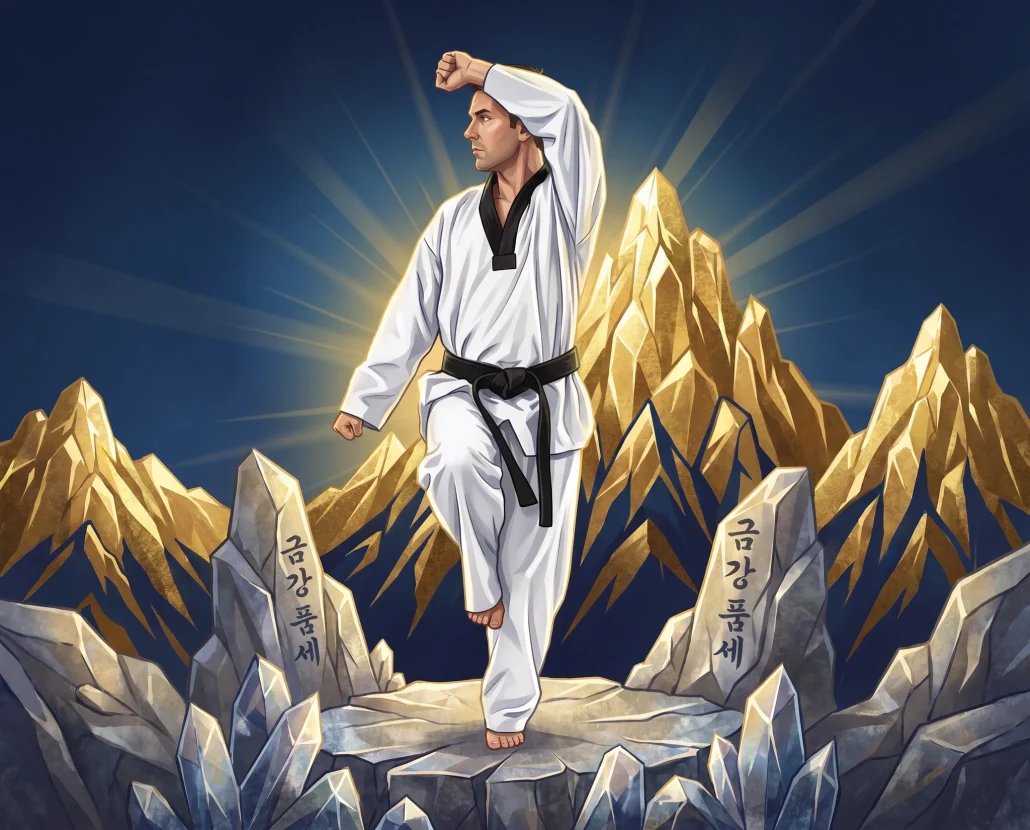
Keumgang
금강
“Koom-Gahng”
Yeon-Mu Line: 山
Meaning: Indestructible
2. Dan Poomsae
山
Keumgang (금강) betyr diamant og symboliserer en hardhet som er så sterk at den ikke kan knuses. Innenfor Taekwondo representerer denne poomsaen en urokkelig åndelig styrke, balanse og majestetisk kraft.
Poomsae Keumgang er det andre mønsteret for sortbelter (2. Dan). Betydningen er dypere forankret i tre sentrale elementer:
1. Tre kilder til symbolikk
- Diamanten (Keumgang-seok): Symboliserer det uknuselige, renhet og hardhet. Det minner utøveren om å ha en mentalitet som ikke lar seg knekke av motgang.
- Keumgang-fjellet (Keumgang-san): Dette fjellet i Korea regnes som et senter for den nasjonale folkesjelen og er kjent for sin ekstreme skjønnhet og majestetiske storhet. Bevegelsene i mønsteret skal utføres like stolt og urokkelig som dette fjellet.
- Keumgang-krigere (Keumgang Yeoksa): Fra gammel buddhistisk historie var dette de mektigste krigerne. De symboliserer mot, maskulinitet og en kropp full av energi som jobber i total harmoni.
2. Bevegelsesmønsteret (山)
Når du går poomsaen på matta, danner trinnene det kinesiske tegnet 山 (Shan), som betyr fjell.
- Den vertikale linjen i midten representerer ryggraden og kroppens sentrale akse.
- De horisontale og sidebøyde linjene symboliserer kraften som skapes når du roterer kroppen.
3. Tekniske og mentale krav
Keumgang skiller seg ut ved å kreve ekstrem fysisk balanse og sindighet. Mønsteret preges av dype, stødige sittestillinger (juchum-seogi) og etbens-stillinger (hakdari-seogi eller tranestilling). Utførelsen krever total fatning, uten rom for frykt, nøling eller uoverveide bevegelser. Målet er å utstråle verdighet og vise at kroppens øvre, nedre, høyre og venstre side beveger seg som én udelelig enhet.
Keumgang
금강
“Koom-Gahng”
Yeon-Mu Line: 山
Meaning: Indestructible
2nd Dan Poomsae
山
Keumgang (sometimes spelled Geumgang) refers to the ultimate strength and heaviness, which represents Mount Keumgang — the energy source of the Korean Peninsula and 호법 Hobeop which refers to the protection of the Buddha-dharma, with the two together constituting the guardians of Yin and Yang.
The name comes from 금강 역사 “Geumgang Yeoksa”, which signifies the strongest warrior who is a master of martial arts and symbolizes masculinity, strength and the indestructible. These factors are blended into the Keumgang Poomsae. Along with being the strongest, Keumgang means radiating light in all directions.
When applied to the human body, it refers to the body’s state full of energy and ready to exert power with any part of the body. This is possible by the coordination of the left and right and upper and lower body to move as one.
Further, it requires composure, no bias toward one side, and no recklessness, fear or hesitation. The Poomsae Line of Keumgang follows the 山 character. The vertical line in the middle represents the central axis of the body and spine while the short lines on the left and right signify the power created by twisting the body left or right from the center line.
When doing Keumgang Poomsae, the practitioner learns rotational moves based on the body center line (spine) to understand how to exert force with powerful moves while keeping the center firm like a big mountain.
“In Keumgang, you train the organic use of your body for ponderous and majestic expression. 금강 막기 Keumgang Makgi (Diamond Block) represents firmness and strength, as the word “Keumgang” suggests. Its Yeon-Mu Line 山 represents grandeur and stability. In practicing Keumgang Poomsae, you have to perform strong, stable but slow moves to develop strength and display the majestic Yudanja.
As all procedures of Keumgang Poomsae require maintaining balance at the same height while connecting the moves, the practitioner must have strong muscles in the lower body.
For example, 바탕손 앞 치기 Batangson Ap Chigi (Palm Heel Forward Strike) is not just a series of hasty moves; it should be ponderous but nimble. 학다리 서기 + 금강 막기 Hakdari Seogi + Keumgang Makgi (Crane Stance + Diamond Block) should be done slowly, straining the whole body, especially the 단전 danjeon (lower abdomen). Additionally, in 주춤 서기 Juchum Seogi (Riding Stance), you will practice shifting the weight and using the central axis of the body.”