
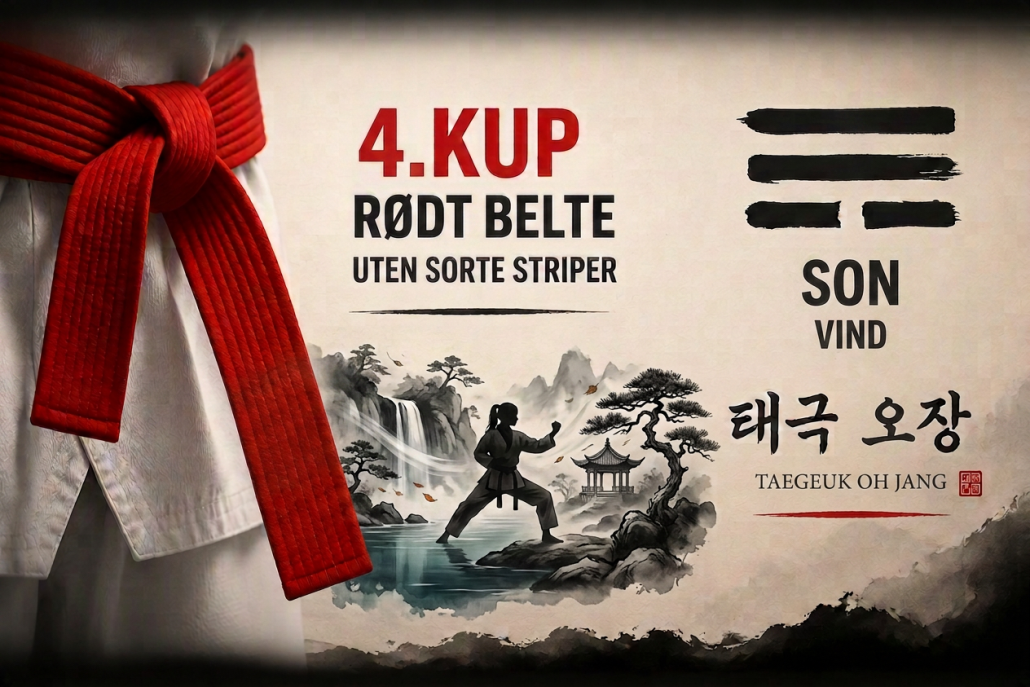
Taegeuk Oh-Jang
태극 오장
Taegeuk 5
“Teyh-Goog Oh-Jahng”
4. kup Poomsae
Trigram: ☴ Son (Vind)
Taegeuk Oh Jang representerer det femte mønsteret i Taekwondo og er knyttet til trigrammet Son (Vind). Det symboliserer fleksibilitet, tilpasningsdyktighet og den formidable kontrasten mellom en mild bris og en herjende storm.
Symbolikk: Vind, fleksibilitet, smidighet og vekslende kraft.
Bevegelser: Veksler dynamisk mellom myke, flytende forberedelser og eksplosive angrep. Introduserer teknikker som albuestøt (palkup chigi), knenebrystslag/svaleslag, ryggneveslag (deung jumeok chigi), samt hoppende og hurtige vendinger.
Filosofisk betydning: Vinden er usynlig og fleksibel, men kan samtidig rive ned alt i sin vei. Mønsteret lærer utøveren å tilpasse seg enhver situasjon med smidighet og ro, for deretter å slå til med uimotståelig, stormfull kraft i det rette øyeblikket.
Taegeuk O-Jang
태극 오장
Taegeuk 5
“Teyh-Goog Oh-Jahng”
4th Geup Poomsae
Trigram: ☴ Wind
Taegeuk 5-Jang represents 선 Seon (風) in Palgwae. Seon symbolizes wind, which is gentle but can abruptly transform into a typhoon. In the human body, it corresponds with the pelvis and hip joint. Meaning, the muscles around the pelvis and hip joint must be relaxed to assume a stable and powerful posture while practicing Poomsae. This part of the body is the base that supports the spine and helps in taking stable and flexible postures. It is also the source of the rotational force and power of kicks. Taegeuk 5-Jang involves the practice of techniques with different postures to exert power diversely, like an unpredictable typhoon.
“In Taegeuk 5-Jang, you will practice techniques using the rotational force of the body’s trunk, including 메 주먹 내려 치기 Me Jumeok Naeryeo Chigi (Hammer Fist Downward Strike), 팔굽 거들어 돌려 치기 Palgup Geodeureo Dollyeo Chigi (Assisted Elbow Hook / Elbow Assisted Turning Strike). You will also practice techniques that connect the moves from outside to inside from left to right, including 안 막기 An Makgi (Inward Block), and techniques that connect the moves in the same direction, including 등 주먹 앞 치기 Deung Jumeok Ap Chigi (Back Fist Forward Strike) and 안 막기 An Makgi (Inward Block). Taegeuk 5-Jang also involves the practice of connecting new 치기 Chigi (Striking) techniques to be used in real fights. Other examples include 메 주먹 바깥 치기 Me Jumeok Bakkat Chigi (Hammer Fist Outward Strike), 팔굽 표적 치기 Palgup Pyojeok Chigi (Elbow Target Strike) and 짓찧기 Jitjjihgi (Stomp).”